
// Installation Instructions
Professional Safety Equipment Installation
Need assistance with installation, parts, or project instructions? Reach out to our customer care team for expert guidance and support.
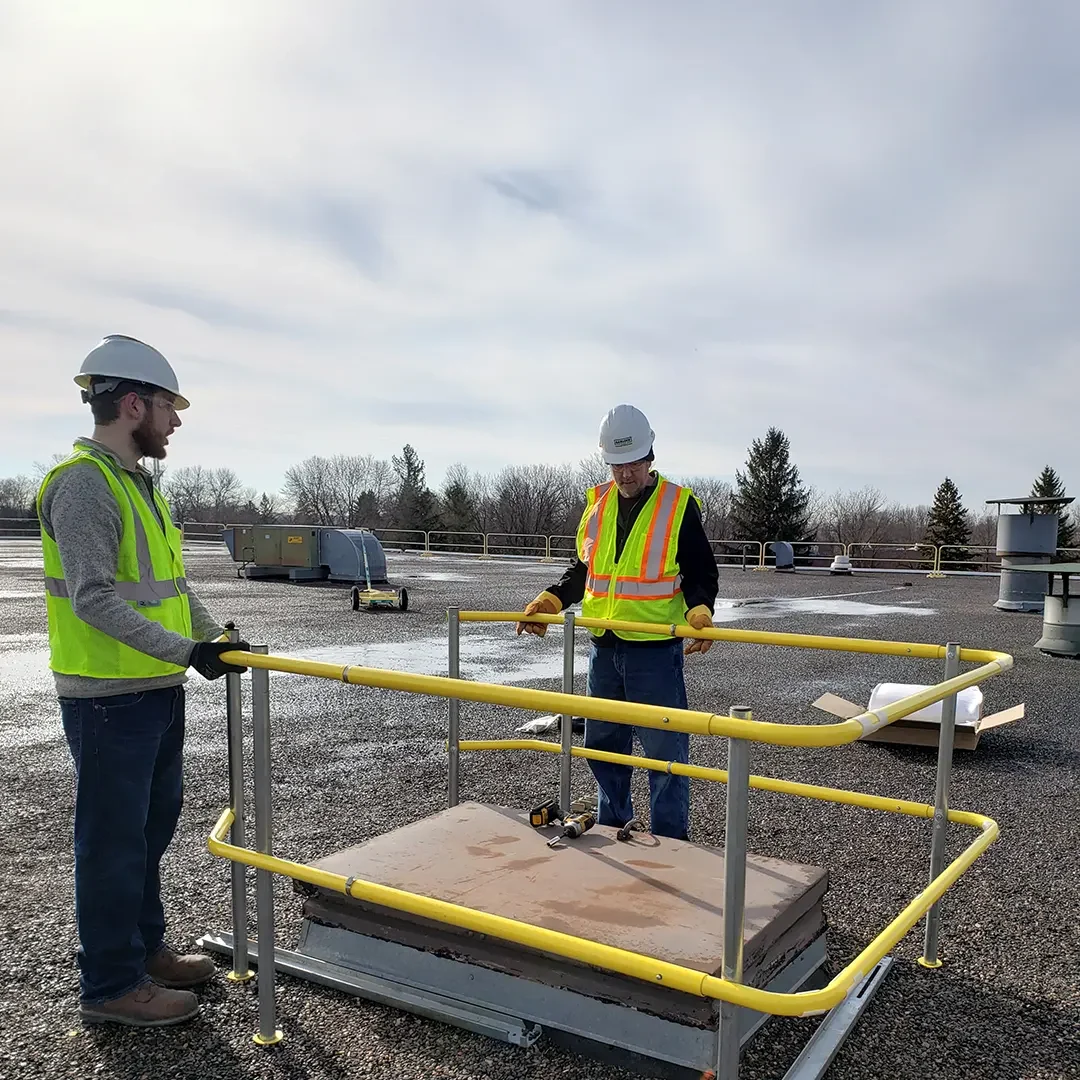
Before downloading this guide, it's important to understand the general OSHA requirements and installation guidelines outlined within. These details will provide a foundational understanding of safety standards and proper installation procedures.
For in-plant products please click here
- RailGuard 200
- RailGuard 200 Fit-Rite
- Crossover Stairs/NeXt Level
- HatchProtector
- LadderGuard
- ScreenGuard
- SkyGuard
- Everlast
Prior to Installation
- RailGuard 200 is designed for use on flat, level surfaces only.
- Do not set up railings or bases near electrical wires. Keep at least 15 feet away from power lines.
- Check load limit of deck before setting up to make certain the deck is strong enough to support the weight of the railing system and other equipment and personnel.
- Never use damaged railings, bases or pins. Always replace damaged components immediately.
- Never set up railings without lock pins.
- Do not exceed 200 lbs. top rail pressure to railings.
- Always use 5 ft. outrigger sections at each end of continuous railing set up.
- Do not use railings for hoisting or anchoring device.
- Avoid setting up on slippery surfaces.
Download RailGuard 200 Manual
Free-Standing Swing Gate Manual
Sliding Gate Manual
Toe Board Manual
Watch Video/Animation on How to Install RailGuard 200
RailGuard 200 installation animation |
RailGuard 200 installation instructions |
Rail Resizer installation instructions |
Prior to Installation
- Identify all work areas that are located within 15 feet of a fall edge of 4 feet or more. This includes any opening such as skylights or hatches.
- Measure the area to be protected. When planning out your installation allow a minimum of 12” from the leading edge to the base.
- Stanchions must to be spaced out no more than 10 feet apart.
(California and other local regulation require less then 10 feet, check local regulations before planning your installation). - The end of every run of rail will require a 5 foot outrigger which consists of a 5-foot section of rail perpendicular to the rail segment. If there is not enough space for a 5 foot outrigger the rail will need to be anchored to a wall or other existing structure or rail.
- Plan out your installation before you start.
- If you need to cut the pipe use a hack saw or reciprocating saw with a metal cutting blade. Remove all sharps burrs to prevent injury.
- Use a 6mm hex wrench to tighten each screw. Tighten to 29.50 ft-lb.
- Always pin each stanchion to base.
- Offset joints when using a pipe union.
- Stanchion is required every 10 feet or less.
- When creating a finished rail the cantilevered rail should not exceed 18” from a stanchion.
- When using Architectural or Curved series stanchions, always curve away from fall hazard.
Download RailGuard 200 Fit-Rite Manual
Watch Video/Animation on How to Install RailGuard 200 Fit-Rite
How to install RailGuard 200 Fit-Rite |
How to install RailGuard 200 Fit-Rite |
Prior to Installation
- When installing the Screenguard, whether over a hole, a dismantled roof hatch or skylight, or a skylight still intact, the worker must be tied-off to an OSHA approved Fall Restraint System until the Screenguard is in place.
- Inspect Screenguard before each work shift for signs of damage, wear or abuse. Make sure it fits securely around skylight or opening.
- Do not sit on, stand on, lay on or climb on the Screenguard protector.
- Do not use Screenguard as a work surface, scaffold platform, ladder, or for any purpose other than to prevent falls through skylights, holes, open or removed roof hatches or HVAC units.
- Do not place or store tools, equipment, toolboxes, plywood or construction/roofing material on top of Screenguard. Screenguard is not to be used for any purpose other than arresting falls.
- The Screenguard is designed to deform when arresting a fall. This absorbs energy and will reduce the forces imparted to the falling persons’ body (“soften the fall”). A ScreenguardTM that has arrested a fall MUST be replaced before work in that area resumes.
- If Screenguard is damaged during transport, from abuse or any other actions, do not fix or repair parts. Take Screenguard out of service and replace it with an undamaged unit.
- Do not use Screenguard over flush-mounted skylights or holes with no raised edges.
- User must verify that Screenguard conforms to locally applicable ordinances and building.